Declarative Web Push — the new, standards-backed way to send web push notifications as plain JSON without a service worker doing any work — has had a remarkable thirteen months. Since shipping in Safari 18.4 in March 2025, it has matured into a W3C Working Draft, gained multi-vendor editorship, and quietly become the preferred format for any team building modern iOS and macOS web push notifications. In this post, we'll walk through where Declarative Web Push stands in April 2026, what's new at the standards level, why the format is already worth adopting today, and how to migrate your push payloads to be future-ready — without breaking a single existing subscriber.
What Is Declarative Web Push?
Traditional web push notifications on the open web have always required a service worker. When a push arrives, the browser wakes the worker, hands it the payload, and the worker calls showNotification() to display the message. It works, but it has trade-offs: every push needs JavaScript to run, every push counts against the browser's “silent push” budget, and every push depends on the service worker still being installed and healthy.
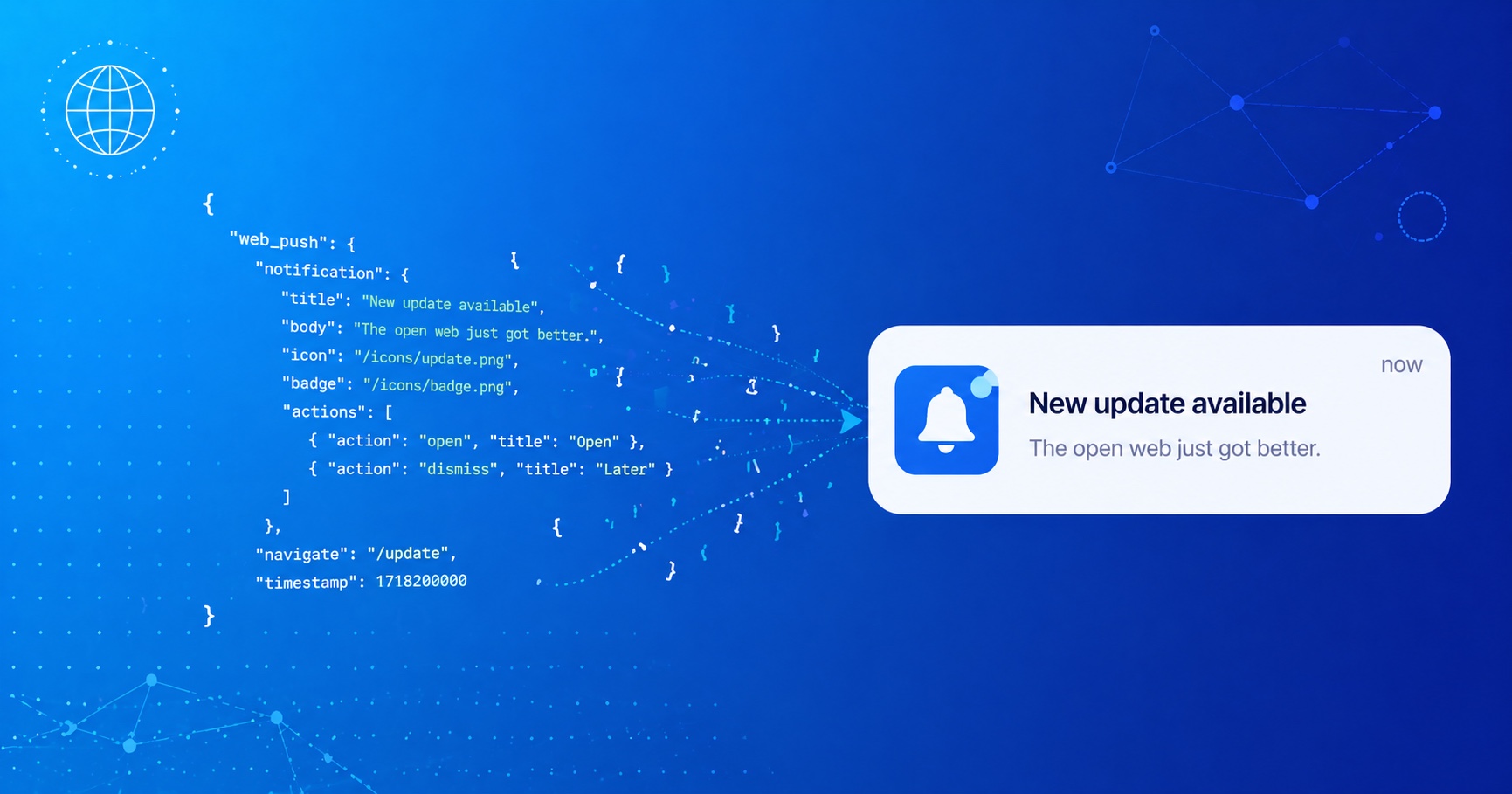
Declarative Web Push changes that. Instead of executing code, the server sends a small JSON document describing the notification, and the browser renders it directly. No service worker code runs. No silent-push penalty. No reliance on third-party JavaScript surviving on the device. The payload looks like this:
{
  "web_push": 8030,
  "notification": {
    "title": "Your order has shipped",
    "body": "Tracking number AT-48201 is on the way.",
    "navigate": "https://example.com/orders/48201",
    "icon": "https://example.com/icon.png",
    "app_badge": 3
  }
}
That's it. The browser sees the magic key "web_push": 8030 (a reference to RFC 8030), parses the notification member, and shows the push. If the optional navigate URL is present, clicking the notification opens that URL automatically — no notificationclick handler required. The optional app_badge field updates the home screen badge in the same step.
Browser Support: A Year of Real-World Shipping
Apple has been the lead implementer, and the rollout has been steady, predictable, and developer-friendly:
- iOS 18.4 / iPadOS 18.4 (March 2025): The first public release. Declarative Web Push works inside Home Screen web apps — sites users have added to their Home Screen.
- macOS 15.5 / Safari 18.5 (May 2025): Declarative Web Push lands on the Mac, both for installed web apps and for any site with notification permission opened in a regular Safari tab. Apple also relaxed Web Push's longstanding “silent push penalty” for declarative messages, since the new format guarantees a user-visible notification every time.
- Safari 26.0 through 26.4 (Sept 2025 — March 2026): The 26.x cycle has been about polishing developer ergonomics rather than shipping new payload features. Notably, Safari 26 added automatic Service Worker pause-on-event in Web Inspector — meaning developers can debug push events that fire before DevTools is even open. That's a quiet but huge productivity win for anyone shipping web push.
- iOS 26 platform behavior: Every site added to the Home Screen now defaults to opening as a web app, even without a manifest. That dramatically expands the surface area of installs that can receive Declarative Web Push without any extra developer configuration.
In other words, every iPhone, iPad, and Mac running a current OS in 2026 can natively render Declarative Web Push payloads — that's an enormous installed base of high-intent, premium devices ready to receive your notifications today.
Standards Progress: The Most Encouraging Story in Web Notifications
The most exciting development isn't the implementation — it's the standards work. Declarative Web Push is now a W3C Working Draft, and the trajectory has been remarkably positive:
- W3C Push API Working Draft (December 1, 2025): The latest Push API Working Draft has fully absorbed Declarative Web Push into the main specification. There's now a normative section titled “Declarative push message” defining the JSON members, the parser algorithm, and the runtime behavior. It's no longer a side proposal — it's part of the core push standard.
- Multi-vendor editorship: The Push API spec is now co-edited by Apple's Marcos Cáceres and Mozilla's Kagami Rosylight. That's a meaningful signal of cross-organization investment in seeing this through.
- Mozilla's standards position is “positive”: Mozilla recorded a public “positive” standards position on Declarative Web Push in February 2025 and has stayed engaged ever since.
- Companion specifications are advancing: The WHATWG Notifications API is gaining URL members so notifications can navigate without service-worker plumbing, and the Badging API is being generalized so the declarative
app_badgefield can update badges without an imperative call.
For a feature that started as a single browser's experiment, having a W3C Working Draft, multi-vendor editorship, and a positive cross-organization position inside thirteen months is a fast, healthy pace by web-platform standards.
Why Adopt Declarative Web Push Today
Here's the part that should excite every marketer and developer working with web push notifications: you don't have to wait for universal browser support to start benefiting. The Declarative Web Push format was designed from day one to be backward compatible with existing service-worker-based pushes. That means adopting it today is a pure upside move.
1. Progressive Enhancement, Not a Migration
When you send a Declarative Web Push payload to a browser that supports it natively, the browser renders the notification directly. When you send the exact same payload to a browser that doesn't yet recognize the format, your service worker still receives the push event and can render the notification the traditional way. Same payload, two delivery paths, zero double work. It's the textbook definition of progressive enhancement — and it's how Apple framed the feature at WWDC25.
2. More Reliable Delivery on Apple Devices
On iOS and macOS, declarative payloads sidestep the service-worker silent-push penalty entirely. Because the OS knows a user-visible notification is guaranteed, declarative messages aren't subject to the same delivery throttling that silent or non-rendering pushes can incur. For brands that rely on push as a primary engagement channel, that's a meaningful reliability improvement on the highest-value mobile platform.
3. A Cleaner, Simpler Server-Side Story
The declarative payload format is just JSON with a stable, standards-defined schema. No bespoke encoding, no service-worker quirks, no per-browser variation in the message envelope. If you're building a push platform — or integrating one — sending standards-shaped JSON is much easier to reason about, log, debug, and replay than ad-hoc payloads.
4. Better Battery and Privacy Behavior
Skipping the service-worker wake-up for every push means lower CPU, lower battery drain, and fewer attack-surface concerns around third-party JavaScript running in the background. Privacy-conscious users on Apple platforms specifically benefit because Intelligent Tracking Prevention can evict service workers without affecting declarative push delivery.
5. You're Future-Ready When the Next Browser Ships
When the next browser ships native Declarative Web Push support — and the standards work strongly suggests another implementation is on the way — sites already sending the new format will get the upgrade automatically. No code changes, no rollout, no migration window. The notifications just start rendering natively for an additional swath of subscribers.
What the Declarative Payload Looks Like in Practice
Migrating an existing payload to the declarative shape usually means three small changes: wrap your fields under a notification object, add the web_push magic key, and rename your click-target field to navigate. Here's a side-by-side example.
Traditional payload (what your service worker reads):
{
  "title": "Flash sale ends tonight",
  "body": "30% off everything until midnight.",
  "icon": "https://example.com/icon.png",
  "click_url": "https://example.com/sale"
}
Declarative Web Push payload (standards-aligned):
{
  "web_push": 8030,
  "notification": {
    "title": "Flash sale ends tonight",
    "body": "30% off everything until midnight.",
    "icon": "https://example.com/icon.png",
    "navigate": "https://example.com/sale"
  }
}
If you want the browser to flag the message as declarative even more explicitly, set the request Content-Type to application/notification+json when you send it:
curl -XPOST "$ENDPOINT" \
    -H "Content-Type: application/notification+json" \
    -H "TTL: 3600" \
    -H "Urgency: high" \
    -d '{"web_push":8030,"notification":{"title":"Hi","body":"World","navigate":"https://example.com"}}'
That's the entire migration. No service worker rewrite, no breaking change, no risk to existing subscribers.
What's Coming Next
The W3C Working Draft is still iterating, and several open pull requests point to where the standard is headed:
- Mutable declarative pushes: A future revision will let your service worker optionally transform a declarative payload before it renders — the best of both worlds, where the browser still guarantees a notification but you can localize, personalize, or A/B-test the contents.
- Window-scoped
pushManager: A pull request to exposepushManageronwindowwould allow sites to subscribe to push without registering a service worker at all — a major simplification for static sites and lightweight integrations. - Notifications API navigation members: The WHATWG Notifications spec is adding native URL fields so the entire click-to-navigate flow works without imperative event handlers.
- Badging API generalization: Updates that let declarative payloads update the home screen badge cleanly across more platforms.
Each of these improvements builds on the same JSON-first foundation, which means sites that adopt Declarative Web Push today will inherit each new capability automatically as it lands.
How Aimtell Fits In
At Aimtell, we've been tracking the Declarative Web Push standard closely because it aligns with everything we believe about modern web push notifications: open standards, low-friction integration, and rock-solid delivery. We're already shipping features that complement the declarative model — including a full-featured push notification inbox API, conversion tracking and attribution, and rich segmentation — so customers get the upside of declarative delivery on Apple platforms without giving up the analytics, automation, and re-engagement tools that make push effective.
If you'd like to see how to implement iOS web push notifications alongside the rest of your push strategy, our team is happy to help you map out a payload plan that's standards-aligned today and ready for whatever ships next.
The Bottom Line
Declarative Web Push is in a stronger position in April 2026 than at any point since its launch. Apple is shipping it across iOS and macOS, the W3C has it on the standards track with multi-vendor editorship, Mozilla's standards position is positive, and the JSON format itself is designed so you can adopt it today without breaking anything. For teams that send web push notifications — especially those reaching audiences on iPhone, iPad, and Mac — the message is clear: there's no reason to wait. Update your payloads, ship the new format, and let your notifications get a quiet quality, reliability, and battery upgrade on every supported device.
Want to start sending standards-aligned web push notifications with Aimtell? Start your free 14-day trial and reach subscribers across every major browser and platform — including Apple's growing Declarative Web Push surface.